


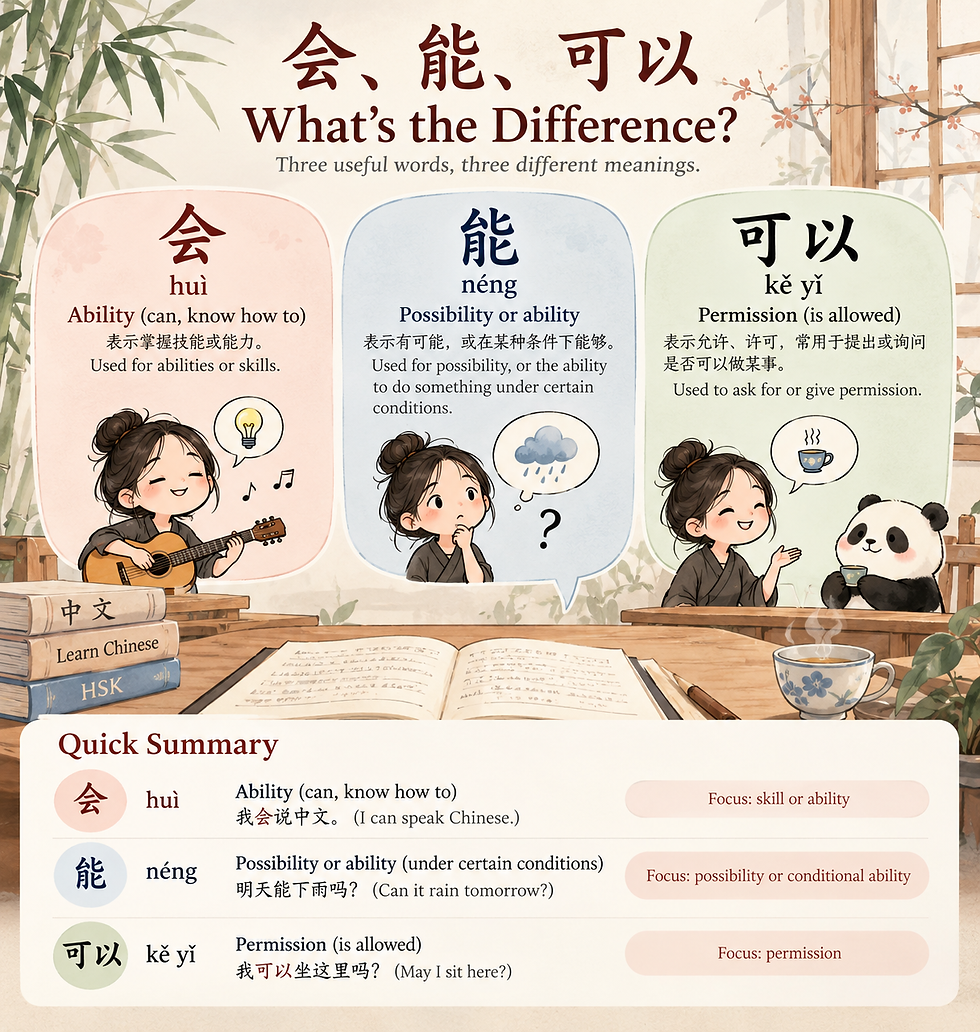
会huì、能néng、可kě以yǐ:What's the Difference?
会、能、可以:What's the Difference?
Have you ever wondered whether to use 会 (huì), 能 (néng), or 可以 (kěyǐ) when speaking Chinese?
All three words can sometimes be translated as can in English, but they are not always interchangeable. Choosing the right one can make your Chinese sound much more natural.
The good news? Once you understand the difference, using them becomes much easier!
In this guide, we'll explore their meanings, look at plenty of practical examples, and practise using them in everyday conversations.
1. 会 (huì) — To Know How to Do Something
We commonly use 会 (huì) to talk about a skill or ability that someone has learned.
Think of skills you acquire through learning or practice, such as speaking a language, swimming, cooking, or playing a musical instrument.
Examples
我会说中文。Wǒ huì shuō Zhōngwén.I can speak Chinese.
她会说英语和法语。Tā huì shuō Yīngyǔ hé Fǎyǔ.She can speak English and French.
你会游泳吗?Nǐ huì yóuyǒng ma?Can you swim?
我不会开车。Wǒ bú huì kāichē.I don't know how to drive.
他会做中国菜。Tā huì zuò Zhōngguó cài.He knows how to cook Chinese food.
你会用筷子吗?Nǐ huì yòng kuàizi ma?Do you know how to use chopsticks?
我不会写这个汉字。Wǒ bú huì xiě zhège Hànzì.I don't know how to write this Chinese character.
More useful expressions
会唱歌 (huì chànggē) — know how to sing
会跳舞 (huì tiàowǔ) — know how to dance
会做饭 (huì zuòfàn) — know how to cook
会骑自行车 (huì qí zìxíngchē) — know how to ride a bicycle
会打篮球 (huì dǎ lánqiú) — know how to play basketball
会用电脑 (huì yòng diànnǎo) — know how to use a computer
What about 不会 (bú huì)?
To say that you don't know how to do something, put 不 (bù) before 会. The pronunciation changes to bú huì because of the third-tone rule.
For example:
我不会说日语。Wǒ bú huì shuō Rìyǔ.I don't know how to speak Japanese.
他不会做饭。Tā bú huì zuòfàn.He doesn't know how to cook.
Remember: 会 usually focuses on a learned skill or ability.
2. 能 (néng) — To Be Able to Do Something
We use 能 (néng) to talk about whether someone is able to do something, whether circumstances allow it, or whether something is possible.
Unlike 会, which often focuses on a learned skill, 能 often focuses on the situation or conditions.
Examples
我今天能去。Wǒ jīntiān néng qù.I can go today.
我明天不能上课。Wǒ míngtiān bù néng shàngkè.I can't attend class tomorrow.
你能帮我一下吗?Nǐ néng bāng wǒ yíxià ma?Can you give me a hand?
你能听见我说话吗?Nǐ néng tīngjiàn wǒ shuōhuà ma?Can you hear me?
我现在不能接电话。Wǒ xiànzài bù néng jiē diànhuà.I can't answer the phone right now.
他生病了,不能去上班。Tā shēngbìng le, bù néng qù shàngbān.He's ill and can't go to work.
你能一个人完成这个工作吗?Nǐ néng yí ge rén wánchéng zhège gōngzuò ma?Can you complete this task on your own?
能 can also express possibility
明天能下雨吗?Míngtiān néng xià yǔ ma?Is it possible that it will rain tomorrow?
我们能在六点以前到吗?Wǒmen néng zài liù diǎn yǐqián dào ma?Can we get there before six o'clock?
你觉得他能通过考试吗?Nǐ juéde tā néng tōngguò kǎoshì ma?Do you think he can pass the exam?
More useful expressions
能看见 (néng kànjiàn) — be able to see
能听见 (néng tīngjiàn) — be able to hear
能参加 (néng cānjiā) — be able to attend or participate
能完成 (néng wánchéng) — be able to complete
能理解 (néng lǐjiě) — be able to understand
能解决 (néng jiějué) — be able to solve
What about 不能 (bù néng)?
不能 often means that someone cannot do something because of their circumstances, limitations, or a restriction.
For example:
我今天很忙,不能跟你吃饭。Wǒ jīntiān hěn máng, bù néng gēn nǐ chīfàn.I'm very busy today, so I can't have a meal with you.
Remember: 能 focuses on ability, possibility, or whether circumstances allow something.
3. 可以 (kěyǐ) — To Be Allowed to Do Something
We commonly use 可以 (kěyǐ) to ask for permission, give permission, or say that something is allowed.
Think of situations involving rules, requests, and polite questions.
Examples
我可以进来吗?Wǒ kěyǐ jìnlái ma?May I come in?
我可以坐这里吗?Wǒ kěyǐ zuò zhèlǐ ma?May I sit here?
我可以问你一个问题吗?Wǒ kěyǐ wèn nǐ yí ge wèntí ma?May I ask you a question?
我可以用一下你的电脑吗?Wǒ kěyǐ yòng yíxià nǐ de diànnǎo ma?May I use your computer for a moment?
这里可以停车。Zhèlǐ kěyǐ tíngchē.Parking is allowed here.
可以 is also useful for making polite requests
我可以借一下你的笔吗?Wǒ kěyǐ jiè yíxià nǐ de bǐ ma?May I borrow your pen for a moment?
我们可以换个时间吗?Wǒmen kěyǐ huàn ge shíjiān ma?Could we change the time?
你可以说慢一点吗?Nǐ kěyǐ shuō màn yìdiǎn ma?Could you speak a little more slowly?
我可以提前十分钟离开吗?Wǒ kěyǐ tíqián shí fēnzhōng líkāi ma?May I leave ten minutes early?
What about 不可以 (bù kěyǐ)?
不可以 means that something is not allowed or permission is not given.
For example:
这里不可以抽烟。Zhèlǐ bù kěyǐ chōuyān.Smoking is not allowed here.
Remember: 可以 commonly focuses on permission, although it can also express practical possibility or suitability.
4. What's the Difference? Compare All Three!
Let's use the same verb to see how the meaning changes.
Imagine you are talking about swimming.
我会游泳。Wǒ huì yóuyǒng.I know how to swim.
This tells us that swimming is a skill you have learned.
我今天能游泳。Wǒ jīntiān néng yóuyǒng.I can swim today.
This focuses on whether the circumstances allow you to swim today. Perhaps you have time and your swimming pool is open.
我可以游泳吗?Wǒ kěyǐ yóuyǒng ma?May I swim?
This asks whether you have permission to swim.
Now let's look at another example: using a phone.
我会用这个手机。Wǒ huì yòng zhège shǒujī.I know how to use this phone.
我现在不能用手机。Wǒ xiànzài bù néng yòng shǒujī.I can't use my phone right now.
Perhaps you are driving or taking an exam.
上课的时候,我不可以用手机。Shàngkè de shíhou, wǒ bù kěyǐ yòng shǒujī.I'm not allowed to use my phone during class.
The first sentence is about skill, the second about circumstances, and the third about permission.
A useful comparison table
Word | Main idea | Example |
会 (huì) | Learned skill | 我会开车。I know how to drive. |
能 (néng) | Ability or circumstances | 我今天能开车。I can drive today. |
可以 (kěyǐ) | Permission | 我可以开车吗?May I drive? |
These are the main distinctions, not absolute rules. In some situations, two or even all three words can be grammatically correct, but the emphasis changes.
5. Can 会 and 能 Sometimes Mean the Same Thing?
Yes! This is where things get interesting.
Both 会 and 能 can describe ability, but they often highlight different aspects of that ability.
Compare:
我会说中文。Wǒ huì shuō Zhōngwén.I know how to speak Chinese.
我能用中文跟你交流。Wǒ néng yòng Zhōngwén gēn nǐ jiāoliú.I can communicate with you in Chinese.
The first sentence focuses on the language skill. The second focuses on being able to communicate in a particular situation.
Now consider:
你会来吗?Nǐ huì lái ma?Will you come?
Here, 会 can express a prediction or something expected to happen.
你能来吗?Nǐ néng lái ma?Can you come?
Here, 能 asks whether you are able to come, perhaps because of your schedule or other circumstances.
你可以来吗?Nǐ kěyǐ lái ma?Can you come? / Would it be possible for you to come?
Depending on the context, 可以 can ask whether coming is possible or acceptable. If you specifically want to ask for permission, it is often clearer to say:
我可以来吗?Wǒ kěyǐ lái ma?May I come?
Notice that English uses can for several different meanings. Chinese often makes these distinctions more explicit.
6. Common Mistakes to Avoid
Mistake 1: Using 会 when you mean permission
If you want to ask whether you may enter a room, say:
我可以进去吗?Wǒ kěyǐ jìnqù ma?May I go in?
会进去吗 would usually suggest whether someone will go in, rather than asking for permission.
Mistake 2: Confusing a lack of skill with a temporary limitation
Compare:
我不会开车。Wǒ bú huì kāichē.I don't know how to drive.
我今天不能开车。Wǒ jīntiān bù néng kāichē.I can't drive today.
The first suggests you haven't learned the skill. The second suggests that something prevents you from driving today.
Mistake 3: Thinking 可以 only means permission
可以 can also express practical possibility or suitability.
For example:
这个时间可以。Zhège shíjiān kěyǐ.This time works.
我们可以明天见面。Wǒmen kěyǐ míngtiān jiànmiàn.We can meet tomorrow.
Here, 可以 is not simply about receiving permission. It indicates that something is possible or acceptable.
Mistake 4: Forgetting the negative forms
会 → 不会 (bú huì) — don't know how to; sometimes won't
能 → 不能 (bù néng) — cannot; not able to
可以 → 不可以 (bù kěyǐ) — not allowed; sometimes not acceptable
Compare:
我不会游泳。 — I don't know how to swim.
我不能游泳。 — I can't swim, perhaps because of an injury or other circumstances.
我不可以在这里游泳。 — I'm not allowed to swim here.
The context matters, but these differences are a very useful starting point.
7. Test Yourself: Which Word Should You Use?
Choose 会, 能, or 可以 to complete each sentence. Think about the meaning before checking the answers!
Question 1
我 ______ 说一点儿中文。Wǒ ___ shuō yìdiǎnr Zhōngwén.I know how to speak a little Chinese.
Question 2
对不起,我今天很忙,______ 跟你出去。Duìbuqǐ, wǒ jīntiān hěn máng, ___ gēn nǐ chūqù.Sorry, I'm busy today and can't go out with you.
Question 3
老师,我 ______ 问一个问题吗?Lǎoshī, wǒ ___ wèn yí ge wèntí ma?Teacher, may I ask a question?
Question 4
他从来没有学过开车,所以他 ______ 开车。Tā cónglái méiyǒu xuéguo kāichē, suǒyǐ tā ___ kāichē.He has never learned to drive, so he doesn't know how to drive.
Question 5
这里是员工休息室,访客不 ______ 进去。Zhèlǐ shì yuángōng xiūxíshì, fǎngkè bù ___ jìnqù.This is the staff room. Visitors are not allowed to enter.
Question 6
我明天有空,



Comments